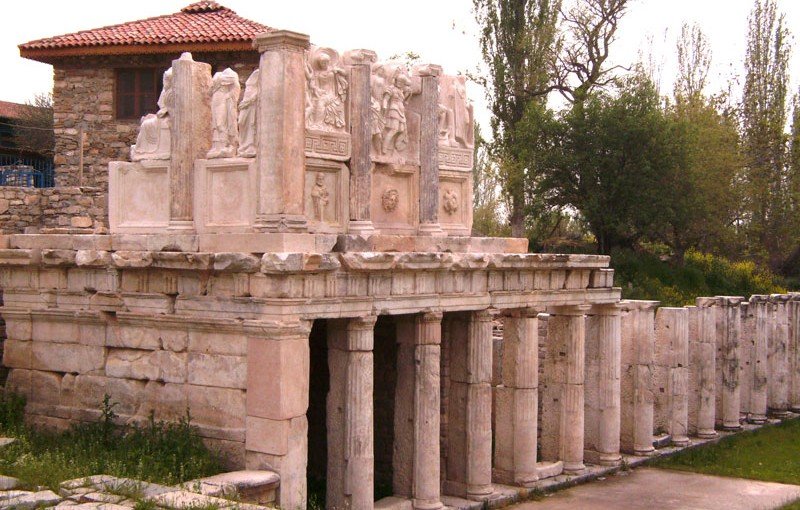
The Sebasteion is one of the most magnificent and remarkable structures of the Ancient City of Aphrodisias. Uncovered in 1979 by Prof. Dr. Kenan Erim, this large temple complex was dedicated to the goddess Aphrodite and to the Julio-Claudian emperors, the first dynasty of the Roman Empire. The inscriptions and archaeological finds from the structure show that this area was a highly important center in Aphrodisias in terms of both religious and political representation.
The name Sebasteion comes from the Greek word “Sebastos.” This word is the Greek equivalent of the Latin title “Augustus” and is associated with meanings such as “revered” and “exalted.” For this reason, the building was not only a sacred space dedicated to Aphrodite, but also a monumental imperial cult complex where the Roman imperial family was honored. In the eastern Roman world, another Sebasteion of this scale and with such a rich relief program is extremely rare.
Location and General Plan of the Sebasteion
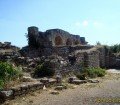
The Sebasteion is located in the city center of Aphrodisias, on an important axis extending from the northern gate toward the theater. The structure runs in an east-west direction and does not fully align with the grid plan of Aphrodisias. This shows that the building carried a special religious and ceremonial meaning independent of the city’s general urban layout.
The complex was organized around a narrow, marble-paved ceremonial street approximately 90 meters long and 14 meters wide. Three-story portico structures rose on both sides of this street. The western end of the ceremonial street connected with the road passing in front of the Tetrapylon. At the eastern end stood the temple section on a podium.
The Sebasteion consisted of three main parts: the two-story entrance building, or propylon, opening onto the street; the three-story porticoes rising on both sides; and the temple at the end of the ceremonial street. This arrangement led visitors from the street level through a narrow and impressive sacred route surrounded by reliefs, ending at the temple area.
Construction Process and Donor Families
Construction of the Sebasteion began during the reign of Emperor Tiberius, in the 20s CE, and continued until around 60 CE, during the reign of Nero. Over this long construction period, the building was completed across several generations and underwent repairs at different times because of earthquakes and structural damage. It is generally accepted that the main parts of the complex were completed during the reign of Claudius.
The inscriptions on the structure show that the Sebasteion was built by two leading Aphrodisian families. The north portico and entrance building were dedicated by Menander, Eusebes, and Eusebes’ wife Apphias. The south portico and temple were dedicated by two other brothers, Diogenes and Attalos. By financing this monument, these families displayed both their loyalty to Rome and their social and political position within Aphrodisias.
In this context, the Sebasteion was not merely a religious building. It was also a space of representation where the relationship between the local aristocracy and the Roman imperial order was monumentalized through marble, inscriptions, and reliefs. In the civic life of Aphrodisias, which had previously been shaped by figures such as Zoilos with strong connections to Rome, aristocratic families now made their own presence visible through the Sebasteion.
Three-Story Porticoes and the Relief Program
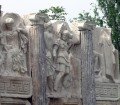
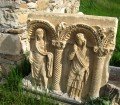
The most striking feature of the Sebasteion is its rich reliefs placed on the three-story porticoes. Panels were set between the columns on the second and third stories of the porticoes. These panels form one of the most comprehensive and original relief programs of the ancient world.
In general, the second-story panels featured mythological scenes, while the third-story panels depicted subjects related to the Roman imperial family. This arrangement brought together the local artistic tradition of Aphrodisias with Roman imperial ideology. Mythology, the imperial family, and civic identity were integrated on the same monumental façade.
The reliefs included mythological subjects such as the Three Graces, the birth of Eros, Apollo at Delphi, Meleager, Achilles and Penthesilea, Nysa and the child Dionysus, Heracles, and Aeneas escaping from Troy. These scenes show how Greek and Anatolian mythological traditions were carved in a rich marble language by Aphrodisian craftsmen.
The imperial panels included scenes related to Augustus, Germanicus, Gaius Caesar, Lucius Caesar, Claudius, Nero, Agrippina, and other members of the Julio-Claudian dynasty. These panels visually expressed the power, legitimacy, and universal rule claimed by the Roman imperial family.
Claudius, Nero, and Imperial Victories
Among the Sebasteion reliefs, the scenes symbolizing Claudius’ victory over Britannia and Nero’s dominance over Armenia are especially striking. In such panels, emperors are presented not only as historical figures, but as rulers who establish order, achieve victory, and unite the world under Roman authority.
These reliefs show how Aphrodisian artists interpreted Roman imperial ideology through a local artistic language. Rome’s military and political achievements were combined with the visual storytelling tradition of Greek mythology. In this way, the Sebasteion became a monument that both declared loyalty to Rome and displayed the artistic power of Aphrodisias.
Some of the panels were damaged by earthquakes and later changes in use. Even so, the surviving reliefs are sufficient to show that the Sebasteion had one of the richest figural architectural programs in the ancient world.
The Aeneas Legend and the Connection with Rome
One of the reasons that encouraged the Aphrodisians to build such a magnificent structure was the mythological connection between Rome and Aphrodite. At the center of this connection lies the Aeneas legend. According to the legend, Aeneas was the son of the goddess Aphrodite and the Trojan prince Anchises. After the Trojan War, he escaped from the ruined city with his father on his shoulders, holding his son’s hand, with the help of the goddess.
After long journeys, the descendants of Aeneas were believed to have reached Italy and become connected with the foundation myth of Rome. For this reason, Rome traced its origins indirectly to Aphrodite. The sacred identity of Aphrodisias, dedicated to Aphrodite, therefore carried a special meaning for the Roman imperial family.
The Sebasteion made this mythological and political connection visible. While Aphrodite was connected with Rome’s origin myth, the Julio-Claudian emperors were presented within a divine and heroic lineage. For this reason, the structure was not merely a local temple complex, but a grand narrative space that transformed Rome’s worldview into Aphrodisian marble art.
Preservation and Display of the Sebasteion Reliefs
Many relief panels belonging to the Sebasteion were uncovered during the excavations. As noted in the original text, more than seventy panels were found. Current studies accept that a significant portion of approximately eighty reliefs has been preserved. These panels were kept for many years in excavation house and storage areas, and later museum arrangements allowed them to be presented to visitors in a clearer way.
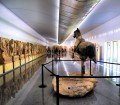
Today, an important part of the Sebasteion reliefs is displayed in the Sevgi Gönül Hall inside the Aphrodisias Museum. This hall presents the panels not only as individual works of art, but also in a way that explains the original architectural and iconographic program of the structure. Visitors can therefore better understand the monumental arrangement of the Sebasteion, the distribution of the reliefs by story, and the building’s relationship with the Roman world.
The Sebasteion reliefs are among the most valuable collection groups of the Aphrodisias Museum. These works clearly show the mastery of Aphrodisian sculptors in marble, the local adaptation of Roman imperial art, and the use of mythological narratives as tools of political representation.
Later Use of the Sebasteion
With the decline of pagan cults and the strengthening of Christianity, the original religious function of the Sebasteion came to an end. The surviving parts of the structure were used for different purposes in later periods. As noted in the original text, the Sebasteion appears to have been used at one time as an area for commerce and daily activity.
As the city became smaller, the building gradually collapsed, was covered by alluvium brought by floodwaters, and later old Geyre village houses were built over it. This shows how the magnificent public spaces of Roman-period Aphrodisias gained different functions within medieval and modern village life.
The rediscovery of the Sebasteion in the 20th century did not simply mean the excavation of a building. This discovery made visible again the place of Aphrodisias in the Roman imperial world, the role of the local aristocracy, and the representational power of ancient art.
Houses, Schools, Churches, and Other Finds
Work around the Sebasteion and its surroundings also contributed to the understanding of other structures from different periods of Aphrodisias. Houses, a school of philosophy, sculptors’ workshops, and late-period religious structures have been uncovered in the city.
In many of these buildings, mosaic floors with figural or geometric designs, handmade objects, ceramic vessels, and finds related to daily life were discovered. These finds show that Aphrodisias was a rich city not only through its temples and monuments, but also through its houses, educational buildings, production areas, and everyday life.
After the earthquakes of the 7th century, some of these houses were abandoned, while others were reused with simpler repairs. This process shows that Aphrodisias did not disappear suddenly, but gradually transformed from a large Roman city into a smaller and more fragmented settlement.
Among the partially uncovered structures are a monastery with its cemetery southwest of the Acropolis and a small basilica southeast of the Theater Baths, later converted into a church. These structures are important for understanding the Christianization process of Aphrodisias and its transformation in Late Antiquity.
The Jewish Community in Aphrodisias
One of the most remarkable inscriptions found in Aphrodisias shows that there was a strong Jewish community in the city. This inscription includes the names of individuals and donors associated with the local synagogue. It lists not only Jews, but also people who were close to Judaism without fully converting.
These individuals are referred to in Greek as “Theosebeis.” This word is interpreted as “God-fearers” or “the devout.” Theosebeis were people who sympathized with the Jewish community, were connected with the synagogue, or made donations, but were not considered to have fully converted to Judaism.
The fact that some people are listed with their professions provides important information about the social structure of Aphrodisias. This document shows that not only pagan and Christian traditions, but also a Jewish community, held an important place in the city. Thus, Aphrodisias appears in Late Antiquity as a multi-religious, multilayered, and socially rich city.
Conclusion
The Sebasteion is one of the strongest monuments expressing the political, religious, and artistic relationship between Aphrodisias and the Roman world. Dedicated to Aphrodite and the Julio-Claudian emperors, this great complex is considered one of the most impressive imperial cult structures of the ancient world, with its ceremonial street, three-story porticoes, temple, rich reliefs, and inscriptions.
The building was a space of representation where Aphrodisian aristocratic families made visible their loyalty to Rome and their power within the city. Mythological scenes, the Aeneas legend, imperial victories, the Julio-Claudian dynasty, and the local artistic language of Aphrodisias came together within the same architectural program.
The later collapse of the Sebasteion, its burial under alluvial deposits, and its location beneath the old Geyre settlement clearly reveal the historical layers of Aphrodisias. Today, the recovered reliefs and architectural remains show not only the archaeological value of the city, but also its artistic and cultural significance.
For this reason, the Sebasteion is one of the most valuable archaeological heritage areas of Aphrodisias. It allows visitors to understand Roman imperial ideology, the cult of Aphrodite, the power of the local aristocracy, mythological narratives, and the extraordinary level of Aphrodisian sculpture all at once.


![[:tr]Prof. Dr. Kenan Erim[:]](https://www.aphrodisias.org/wp-content/uploads/2014/12/prof-dr-kenan-erim-120x105.jpg)