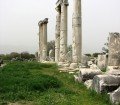
The Aphrodisias Odeon is one of the most important public buildings of the ancient city. The structure is considered both a roofed hall used for concerts and performances and a Bouleuterion, where the city council held its meetings. For this reason, it was not only a venue for artistic events but also an important center that brought together the political, cultural, and social life of Aphrodisias.
The Odeon is located between the Temple of Aphrodite and the North Agora, in one of the central public areas of the city. Its location shows that the building was connected both with the sacred area and with the agora, the heart of civic life. In this respect, the Odeon stands at a special point where religious, administrative, and social life intersected in Aphrodisias.
Function of the Odeon
In ancient cities, odeons were generally used for musical performances, poetry readings, speeches, meetings, small-scale theatrical events, and concerts. The building at Aphrodisias served these functions and also functioned as the meeting place of the city council. Therefore, describing it only as a “concert hall” would be incomplete. More accurately, it was a multifunctional public building that combined the roles of a council house and a roofed performance hall.
The Aphrodisias Odeon is estimated to have had a capacity of around 1,700 people. This capacity shows that it was not a small meeting room but a large covered hall capable of hosting the city’s leading figures, citizens, and different groups. The building can be understood as a space where public decision-making and cultural events were experienced under the same architectural roof.
Architectural Features
The Aphrodisias Odeon has a semicircular, theater-like seating arrangement. The lower seating rows have survived in a well-preserved condition. The upper rows, however, appear to have collapsed over time, especially as a result of earthquakes and structural deterioration. The building is thought to have been covered in antiquity by a wooden roof. This feature is one of the main elements distinguishing the Odeon from an open-air theater.
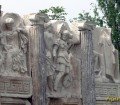
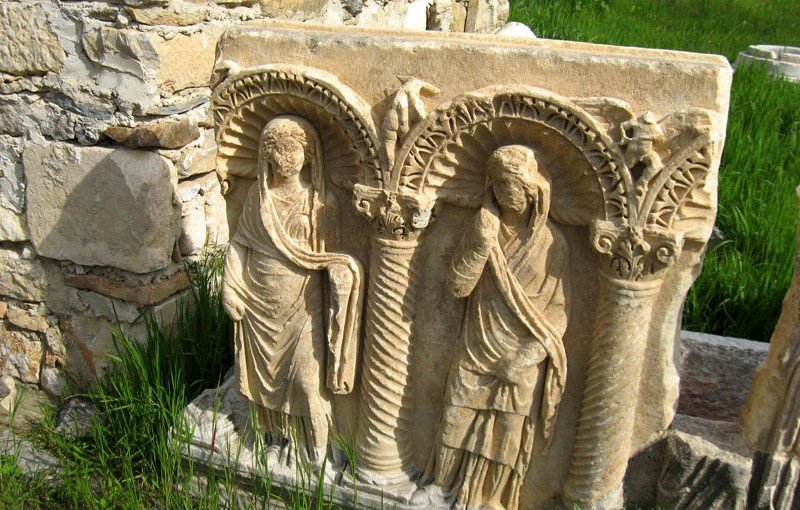
The stage façade of the Odeon had a two-story, marble-columned, and richly decorated arrangement. In the niches and between the columns of the stage building stood statues representing distinguished citizens, benefactors, and important individuals of Aphrodisias. These statues show that the building had not only a functional character but also a representative and honorific role.
The marble workmanship used in the building is consistent with the sculptural and architectural decoration tradition of Aphrodisias. The high-quality stone obtained from the marble quarries near the city appears both in the architectural elements and in the statues. For this reason, the Odeon is one of the important buildings that reflects Aphrodisias’ understanding of architecture, art, and public representation at the same time.
Orchestra, Flooring, and Water Issues
In front of the semicircular seating area of the Odeon is an orchestra space. This was the central area where events took place. Older descriptions mention that the orchestra was paved with colored marble flooring known as opus sectile. Such pavements were made by arranging pieces of marble in different colors into geometric patterns and reflect the refined decorative approach of Roman interior spaces.
The area where the building stands is associated with fault lines and water accumulation problems. For this reason, water may collect in the orchestra section, especially during rainy periods. This situation reveals not only the architectural richness of Aphrodisias but also the natural and geological challenges faced in preserving ancient buildings.
The removal and protection of some floor elements is important for the long-term conservation of ancient remains. In archaeological sites such as Aphrodisias, where structures are exposed to open-air conditions, architectural remains and decorative elements require continuous maintenance, documentation, and conservation.
Statues and Public Representation
Many statues and statue fragments were uncovered during excavations in the Odeon. Full-length statues of distinguished individuals from the city once stood on high bases along the stage façade. These statues show how benefaction, public service, and social prestige were made visible in Aphrodisian society.
In ancient cities, statues placed in public buildings were not merely decorative. They honored individuals who had served the city, kept local memory alive, and conveyed political, social, and cultural messages to viewers. In this sense, the Aphrodisias Odeon functioned as a space of public honor.
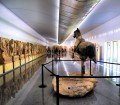
The works found in and around the stage façade are now considered important parts of the Aphrodisias Museum collection. These pieces are highly valuable for understanding both the city’s portrait tradition and the technical mastery of Aphrodisian craftsmen in marble.
Relationship with the Sculptor’s Workshop
Completed and unfinished sculpture fragments were found to the north of the Odeon or in its immediate surroundings. These finds suggest the presence of a sculptor’s workshop in the area. According to current research, the sculptor’s workshop at Aphrodisias was located in a small stoa north of the Council House and in the open area immediately to its south.
This workshop is highly valuable for understanding Aphrodisias’ artistic production in the ancient world. Unfinished statues show the stages through which marble blocks were worked, the techniques used, and the working methods of the craftsmen. Thus, the unfinished sculptures displayed in the Aphrodisias Museum should be seen not only as works of art but also as documents of the ancient production process.
The Aphrodisias School of Sculpture gained great fame throughout the Roman Imperial period. The workshop finds around the Odeon show how closely this production tradition was connected with the central public spaces of the city.
The Bishop’s Palace and the Triconch Building
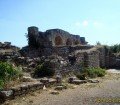
The large late-period building complex located to the south of the Odeon or nearby has traditionally been called the Bishop’s Palace. However, current academic studies show that the history of this structure is more complex. It was probably used in the Late Roman period as an elite residence or an administrative representative building, and in later phases it was associated with the bishopric.
The building is also known as the Triconch House because of its large three-apsed hall. Its broad peristyle courtyard, private rooms, apsidal reception hall, and monumental scale show that the structure was connected with elite life and administrative order in late-period Aphrodisias.
The name “Bishop’s Palace” may be appropriate for the latest phases of use. However, defining the building only as a bishop’s residence after the adoption of Christianity would overlook its earlier Late Roman history. Therefore, the structure should be discussed within both the context of Late Roman domestic architecture and the later Christian urban order.
Its Place in the Urban Life of Aphrodisias
The Odeon, sculptor’s workshop, and Bishop’s Palace area should be evaluated together in order to understand the central public fabric of Aphrodisias. In this area, council meetings, musical performances, poetry and speech events, sculpture production, public honor, and late administrative structures existed side by side.
This density shows that Aphrodisias gained a strong urban identity not only through major monuments such as the temple and stadium, but also through more complex buildings that shaped daily public life. The Odeon is one of the liveliest parts of this identity. Here, citizens gathered, decisions were made, performances were watched, and important individuals were honored through statues.
In Late Antiquity, the same area changed according to new administrative and religious needs. The building known as the Bishop’s Palace and the transformations around it are important for understanding the transition of Aphrodisias from a pagan Roman city to a Christianized late antique city.
Conclusion
The Aphrodisias Odeon is a multifunctional building that brought together the public, cultural, and political life of the ancient city. Used for concerts, speeches, musical performances, and council meetings, the structure stands out with its capacity of around 1,700 people, semicircular seating arrangement, marble stage façade, and statue program.
The sculptor’s workshop around the Odeon reveals the strength of Aphrodisias in artistic production, while the late-period building complex known as the Bishop’s Palace reflects the city’s transformation during the Late Roman and Christianization periods. For this reason, the Odeon and its surroundings are essential not only for understanding the architecture of Aphrodisias but also its social, artistic, political, and religious history.
Today, this area is an important part of the city’s archaeological heritage, offering visitors the opportunity to understand the roofed performance spaces, council building, sculpture production, and late-period urban life of Aphrodisias together.