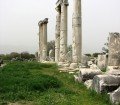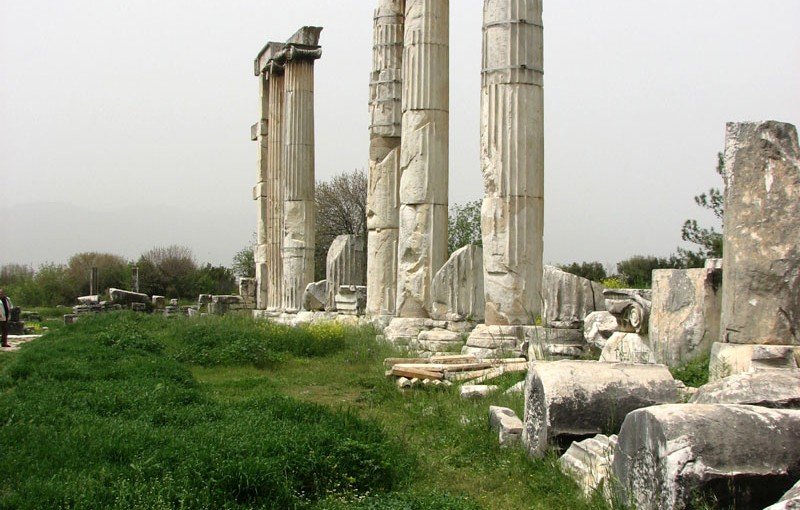
The Temple of Aphrodite is one of the most important structures of the Ancient City of Aphrodisias. The name, identity, and fame of the city in the ancient world were largely shaped around this temple and the cult of Aphrodite that developed here. In Aphrodisias, the sanctuary was not only a religious center, but also a central focus that defined the city’s political prestige, artistic production, and collective memory.
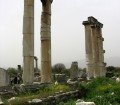
Today, the structure seen near the sculpture school, with fourteen columns rising toward the blue sky, is regarded as the place where the heart of the ancient city once beat. Although these columns do not fully reflect the grandeur of the building in the Roman period, they strongly convey the sacred and monumental character of Aphrodisias.
The Origin of the Cult of Aphrodite
In traditional accounts, the origin of the cult of Aphrodite is associated with Ishtar, the Mesopotamian goddess of love and fertility. Interpretations involving figures such as Nineveh, Ninos, and Semiramis have a meaningful place within the naming traditions and legendary world of Aphrodisias. However, these narratives should not all be treated as definite archaeological evidence.
Current research shows that the Aphrodite worshipped at Aphrodisias was a distinctive figure combining the qualities of a local Anatolian fertility goddess with the Hellenic concept of Aphrodite as the goddess of love and beauty. Therefore, the Aphrodite of Aphrodisias cannot be explained only through the Aphrodite of classical Greek mythology. She was a local cult image that also carried older Anatolian mother goddess and fertility traditions.
This multilayered religious identity explains why Aphrodisias became an important sacred center in antiquity. The city’s dedication to Aphrodite also played a role in its relations with Rome and contributed to the political privileges it gained during the periods of Sulla, Julius Caesar, and Augustus.
Early Phases of the Temple
The original text states that the first construction of the temple goes back to the Archaic period. This statement should be approached carefully. Research beneath the temple has revealed Archaic pottery, traces of early structures, and some Hellenistic remains. However, these finds do not prove with certainty that there was an Archaic temple on the same plan beneath the Roman-period building visible today.
For this reason, it is possible to trace the history of the Aphrodite sanctuary back to the Archaic period, but the architectural history of the visible Temple of Aphrodite should be explained mainly through the Late Hellenistic and Roman periods. The sanctuary had an older cult tradition, but the existing temple structure is generally understood as taking shape especially from the late 1st century BCE onward.
The first major construction phase of the temple began in the 30s BCE with the support of Gaius Julius Zoilos. The mention of Zoilos in the inscription on the door lintel is an important piece of evidence for dating the early phase of the building. In later periods, the addition of columns and the organization of the surrounding sanctuary gave the temple its monumental character.
Architectural Features
The temple was a structure built entirely of marble in the Ionic order, a style characteristic of Anatolia. It had eight columns on the short façades and thirteen columns on the long sides. Technically, the structure had a pseudo-dipteral plan. This means that the broad colonnaded arrangement around the temple chamber, known as the cella, created the impression that the building was surrounded by two rows of columns.
This plan type made the structure appear wider and more impressive from the outside. The proportions, spacing, and surrounding arrangement of the columns show that the temple was designed not only for worship but also to create a strong visual impact. Aphrodisian marble craftsmen skillfully combined traditional Hellenistic forms with the possibilities offered by local stonework.
In the 1st century CE, the outer colonnades were added. In the 2nd century CE, the temple was surrounded by a larger colonnaded courtyard system. During the reign of Emperor Hadrian, the completion of the porticoed arrangements around the sanctuary gave the structure a more monumental appearance. The sacred area was entered through a monumental entrance arrangement on the eastern side.
The Cella and the Cult Statue
Inside the temple was the cella, the sacred chamber that only priests could enter. This room contained the cult statue of the goddess. This statue was the most important object defining the religious identity of Aphrodisias.
The Aphrodite of Aphrodisias was depicted in a long garment, with a rigid frontal posture in which the body was enclosed like a column. Her arms extended forward. On the bands and panels of her garment were various symbolic scenes. These included figures such as the sun and moon deities, the Three Graces, Aphrodite, and Erotes. Some scenes included symbols related to the sea, fertility, nature, and cosmic order.
In this respect, the Aphrodite of Aphrodisias can be compared with powerful Anatolian cult images such as Artemis of Ephesus. However, the goddess of Aphrodisias had her own distinctive identity. The statue brought together the local fertility goddess tradition and the Hellenic image of Aphrodite in a single figure.
Priests, Asylum, and the Identity of a Pilgrimage Center
The Temple of Aphrodite was an important religious center in antiquity. As noted in the original text, the temple functioned like a pilgrimage place in the pagan world and was regarded as a sacred space that protected those who sought refuge there. In the ancient world, some temples were known to possess the right of asylum. Within the privileged relationship that Aphrodisias established with Rome, this sacred status held an important place.
Priests served in the temple. Although older accounts suggest that only male priests worked there, priest and priestess statues and inscriptions from Aphrodisias show that the religious hierarchy of the sanctuary was more complex. Therefore, rather than reducing the temple’s religious personnel to a single group, it is more accurate to say that elite families and religious officials in the city were closely connected with this sacred center.
The Temple of Aphrodite formed the core of the city center and its identity. The city plan of Aphrodisias developed largely around this sanctuary, yet the temple did not fully align with the regular grid plan of the city. This shows that the temple had an older and special sacred orientation.
Conversion of the Temple into a Church
In the mid or late 5th century CE, with the Christianization of the city, the Temple of Aphrodite was converted into a large Christian basilica. This transformation is one of the most remarkable examples of a temple-to-church conversion in the ancient world.
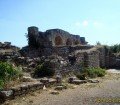
During the conversion, the cella walls of the temple were dismantled, the columns on the short sides were added to the long sides, and the building was extended along an east-west axis. In this way, a three-aisled basilical plan was created. A narthex was added to the west, and a semicircular apse was added to the east. The colonnaded arrangement and architectural elements surrounding the temple were reused in the new church structure.
This transformation meant that the building was almost turned inside out architecturally. The house of the goddess in the pagan period became the cathedral church of the city in the Christian period. The major change in the religious identity of Aphrodisias can be read directly in the stones of this building.
Wall Paintings, Graves, and Later Use
Traces of paintings are reported in the apse and on some wall surfaces of the church. Older accounts mention Christian figures such as Jesus, Mary, Gabriel, and Michael in these paintings. Such paintings show that the interior of the temple was rearranged according to its new religious identity during its use as a church.
During the church period, graves were built inside the structure and in the courtyard area. These burials show that sacred spaces continued to be used as burial areas during Late Antiquity and the Middle Ages. However, these burials and later interventions damaged some early layers that were important for archaeologists.
The church was used throughout the Middle Ages, but it suffered major damage from attacks and fire in the late 12th century. Even so, fourteen columns, important sections of the outer walls, and the apse have survived to the present day. The structure visible today carries the traces of both the Roman-period Temple of Aphrodite and its Late Antique transformation into a church.
The Account of George Tornikes
George Tornikes, who visited the region in the 12th century, described the abandoned state of the church after earthquakes and destruction. The account mentioned in the original text shows that the building had ceased to function as a center of worship and had become a ruin. Such late testimonies are valuable for understanding the transformation of Aphrodisias from a great Roman city into a smaller and partly abandoned medieval settlement.
In this account, the silence, emptiness, and ruin of the church stand out. The historical journey of the Temple of Aphrodite thus becomes a multilayered story. It was first the sanctuary of a local goddess, then the magnificent marble temple of the Roman period, later a Christian cathedral church, and finally a medieval ruin.
Conclusion
The Temple of Aphrodite is the center of the religious, political, artistic, and urban identity of Aphrodisias. The temple developed as a monumental Roman structure in the late 1st century BCE on the basis of an older sacred tradition. It was enriched with colonnaded arrangements in the 1st and 2nd centuries CE and completed with the surrounding sanctuary architecture during the Hadrianic period.
The cult statue inside the building created a distinctive religious identity by combining the local Anatolian fertility goddess tradition with the Hellenic image of Aphrodite. This identity strengthened the fame of Aphrodisias in the ancient world and its special relationship with Rome.
The conversion of the temple into a church in the late 5th century CE is one of the strongest architectural proofs of the Christianization of Aphrodisias. The columns, apse, walls, and architectural traces that survive today show all the roles this structure assumed in different periods.
For this reason, the Temple of Aphrodite is not only the most important sacred building of Aphrodisias, but also one of the most valuable archaeological heritage sites in ancient Anatolia, where religion, architecture, urban identity, and cultural transformation can be traced together.