Ancient City of Aphrodisias is one of the best-preserved Roman-period cities, located within the boundaries of Geyre Neighborhood in the Karacasu district of Aydın, in the ancient region of Caria. The city stands out especially for the cult of Aphrodite, its marble sculptural tradition, monumental buildings, inscriptions, and well-preserved urban fabric. To understand the history of Aphrodisias today, its defensive system, city plan, and religious centers should be evaluated together.
The City Walls of Aphrodisias
The city walls surrounding Aphrodisias are approximately 3.5 kilometers long. These walls form a wide and well-preserved defensive line enclosing the ancient city center. According to research, the walls surrounded an area of approximately 72 hectares. With a height of at least 10 meters and a thickness of approximately 2.5 to 3.5 meters, this structure is considered one of the largest construction projects of Aphrodisias in Late Antiquity.
The precise dating of the walls can be made through inscriptions on the gates. Inscriptions on two gates mention the names of the officials who financed their construction. These inscriptions indicate that the walls were built in the 350s or 360s CE. Before this date, Aphrodisias is thought not to have been a fully walled city.
The construction of the city walls significantly changed the appearance of Aphrodisias and the movement pattern within the city. Previously, Aphrodisias had a more open urban layout. With the construction of the walls, it became a more enclosed city where entrances and exits were controlled through specific gates. The number of known gates today is seven. This shows that the older statement referring to “four main gates” may be incomplete.
One of the striking features of the walls is that they were built with reused stone blocks. The outer face largely contains marble blocks taken from earlier tombs, monuments, and various architectural structures. Some of these blocks are decorated with reliefs, inscriptions, or ornaments. For this reason, the walls of Aphrodisias are not only a defensive structure but also a large stone archive preserving traces of the city’s earlier architectural and social history.
The Gothic incursions that affected Western Anatolia in 260 CE may have increased the need for security in the region. However, current archaeological and epigraphic evidence shows that the walls of Aphrodisias were not built immediately after this event, but later, in the mid-4th century. Therefore, the walls should not be understood merely as a simple defensive line built against an immediate military threat. It is more accurate to evaluate them as part of the changing administrative, political, and urban identity of Aphrodisias in Late Antiquity.
City Plan and Urban Fabric
Aphrodisias had a regular city plan, especially from the Late Hellenistic period onward. Many structures in the city were arranged according to a grid plan consisting of streets intersecting at right angles. This planning approach allowed public spaces, streets, and building blocks in ancient cities to be organized more systematically.
However, some important buildings in Aphrodisias do not fully conform to this grid plan. In particular, the Temple of Aphrodite and Sebasteion are not fully aligned with the general street layout of the city. This shows that the religious, ceremonial, and symbolic importance of certain structures could be more decisive than the geometric order of the urban plan.
UNESCO’s evaluation of Aphrodisias also notes that the city had an orthogonal street plan, while some buildings, such as the Temple of Aphrodite, did not fully conform to this arrangement. This feature shows that Aphrodisias was not only a planned Roman city, but also a place where older sacred areas and special religious traditions continued to influence the urban fabric.
The Temple of Aphrodite
The Temple of Aphrodite was the religious and symbolic center of Aphrodisias. The city’s name, identity, and sacred character were largely connected with this temple and the cult of Aphrodite that developed there. In Aphrodisias, the temple was not only a place of worship but also a center that strengthened the political and cultural prestige of the city.
The temple was a monumental structure built entirely of marble and surrounded by columns. Architecturally, it was designed in the Ionic order and followed the tradition of Hellenistic temple architecture. Technically, it had a pseudo-dipteral plan, an eight-column façade, and closely spaced columns. There were thirteen columns along each of its long sides.
The first phase of the temple is dated to the 30s BCE through inscriptions. In this first phase, the cella, meaning the temple chamber, and the columned entrance section were built. In the 1st century CE, outer colonnades were added around the temple. In the 2nd century CE, the temple was surrounded by a larger colonnaded courtyard system. This process shows the increasingly monumental architectural program of Aphrodisias during the Roman period.
Research under the temple has revealed Archaic-period ceramics and traces of early structures with different orientations. However, these finds do not prove that there was definitely an Archaic temple in the same location beneath the existing Roman-period temple. Therefore, instead of defining the temple directly as an Archaic structure, it is more accurate to state that the sacred area had a much older history of use.
The Cult of Aphrodite and the Cult Statue
One of the most important elements defining the identity of Aphrodisias was the cult of Aphrodite. The Aphrodite worshipped here should not be understood only as the goddess of love and beauty in the classical Greek world. The Aphrodite of Aphrodisias was a distinctive cult figure combining features of a local Anatolian fertility goddess with the Hellenic image of Aphrodite.
Inside the temple stood the goddess’s cult statue. This statue was one of the most important objects representing the religious identity of the city. According to UNESCO’s evaluation, the Aphrodite of Aphrodisias brought together the qualities of a local Anatolian fertility goddess and the Hellenic image of Aphrodite.
As Christianity gained strength in the region, the public importance of this cult gradually declined. However, the influence of the cult of Aphrodite continued in Aphrodisias for a long time, and the temple was not converted into a church until around 500 CE. This shows that the religious identity of the ancient city changed gradually throughout Late Antiquity.
Conversion of the Temple into a Christian Basilica
In the mid or late 5th century CE, the Temple of Aphrodite was converted into a Christian basilica. This transformation is one of the most remarkable examples of pagan temples being converted into churches in the ancient world. UNESCO considers this conversion a special example among known temple-to-church transformations in terms of engineering and architectural impact.
During the conversion, the structure of the temple was greatly altered. The cella walls were dismantled, the columns were rearranged, and the building was transformed into a church with an entrance from the west and an apse in the east. The side columns were incorporated into the nave arrangement of the new basilica, while the end columns were used to extend the building to the east and west. Parts of the temple’s surrounding colonnaded order were reused in the narthex and courtyard arrangement.
In this process, the temple did not merely change function. Architecturally, it was almost turned inside out. The building that had been the center of a pagan sacred area became the cathedral church of the city in the Christian period. This transformation marks a major turning point in the religious and social history of Aphrodisias.
The church continued to be used throughout the Middle Ages. The structure was heavily damaged by attacks and fire in the late 12th century, but many of its columns and outer walls remained standing. The remains visible today largely reflect the complex architectural heritage created by the Roman-period Temple of Aphrodite and its Late Antique church conversion.
Sebasteion and Its Relationship with the City Plan
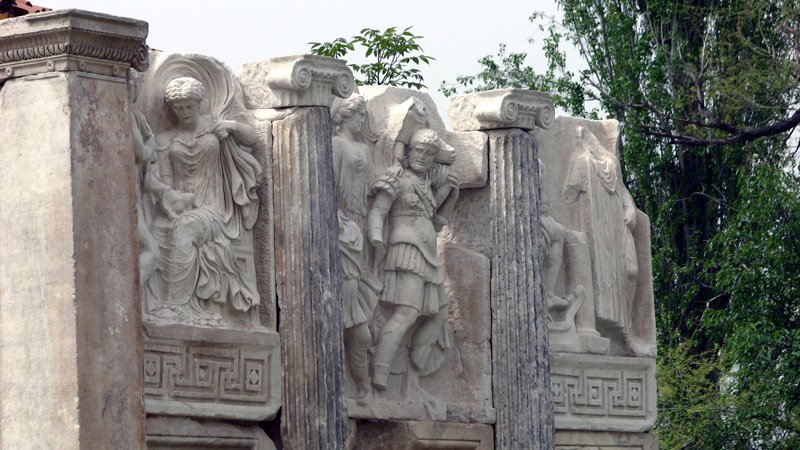
One of the most remarkable structures in the urban fabric of Aphrodisias is the Sebasteion. Built between 20 and 60 CE, this monumental complex was dedicated to Aphrodite and the Julio-Claudian dynasty. With its narrow ceremonial street, three-story porticoes rising on both sides, and relief-decorated façades, the Sebasteion is one of the most important indicators of Aphrodisias’ political and religious connection with the Roman world.
Like the Temple of Aphrodite, the Sebasteion does not fully conform to the general grid plan of the city. This shows that in Aphrodisias, some sacred and ceremonial buildings were positioned independently of the regular axes of the city plan. The reliefs of the Sebasteion combine imperial ideology, Greek mythology, and the local identity of Aphrodisias within a single visual program.
Conclusion
The city walls of Aphrodisias and the Temple of Aphrodite are two essential building groups for understanding the historical transformation of the ancient city. The walls represent a major construction project connected with the changing security needs, administrative structure, and urban identity of Aphrodisias in Late Antiquity. With their reused marble blocks, these walls also carry traces of the city’s earlier monuments into the present.
The Temple of Aphrodite was the center of Aphrodisias’ religious identity. As the most important sacred building of the city during the Roman period, the temple was transformed into a Christian basilica in Late Antiquity. In this way, the city’s pagan past and Christian period came together within the same architectural structure.
Today, visitors to Aphrodisias can read the city’s defensive and late-period history through its walls, and its religious transformation through the temple. These structures show that Aphrodisias is not only a well-preserved ancient city, but also a multilayered archaeological heritage site that carries the traces of different periods on top of one another.



![[:en]Unesco World Heritage Site[:]](https://www.aphrodisias.org/wp-content/uploads/2017/07/unesco-120x105.jpg)