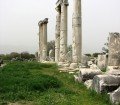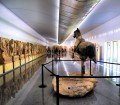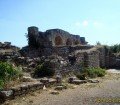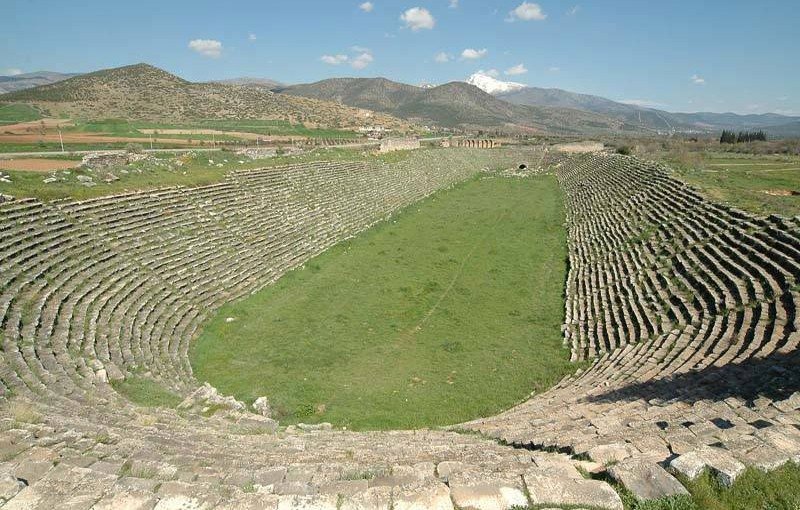
Aphrodisias Stadium is one of the most impressive structures of the Ancient City of Aphrodisias, located within the boundaries of Geyre Neighborhood in the Karacasu district of Aydın. Situated in the northern part of the city, this monumental structure is considered one of the best-preserved stadiums not only in Aphrodisias but also in the ancient world. Its scale, architectural integrity, and surviving seating rows provide important insights into the social, athletic, and public life of Aphrodisias during the Roman period.
Aphrodisias was an important city that developed in the fertile valley formed by the Dandalaz, or Morsynus, Stream in the ancient region of Caria. Known for its marble quarries, sculptural tradition, inscriptions, monumental buildings, and organized urban plan, the stadium was one of the main public spaces where large crowds gathered. In this respect, Aphrodisias Stadium was not only a sports venue but also a major meeting place reflecting the social life of the city.
Location and Architectural Features
The stadium is located in the northern part of Aphrodisias. Its position within the city plan shows that the structure had a strong relationship with the urban fabric. Spectators entered the stadium through monumental stairways on the southern side, while competitors used the tunnels beneath the seating rows at the two short ends. This entrance arrangement shows that the stadium was designed not merely as an isolated structure, but as a planned part of the city.
The structure is approximately 270 meters long and 60 meters wide, with a seating capacity of around 30,000 people. The marble seating rows consist of thirty tiers. Considering the population of the ancient city, this capacity is remarkable. The large scale of the stadium suggests that Aphrodisias served not only its own residents but also visitors, athletes, and festival participants from surrounding cities.
One of the most distinctive architectural features of Aphrodisias Stadium is that both of its short ends are closed. Most ancient Greek stadiums were designed with one open end, while the closed ends of the Aphrodisias Stadium give it a special form approaching that of an amphitheater. The slightly elliptical shape of the long sides is considered a deliberate architectural solution that allowed spectators to view the events more comfortably.
Exceptional Preservation in the Ancient World
Aphrodisias Stadium stands out among similar ancient structures for its exceptional state of preservation. Many ancient stadiums were damaged over time, dismantled, or reused as sources of building stone. Aphrodisias Stadium, however, has largely preserved its original form, seating arrangement, and plan.
This preservation makes the stadium impressive for visitors, but it also creates an important field of study for archaeologists, architectural historians, epigraphists, and researchers of ancient sports. Its architecture, seating rows, entrance system, inscriptions, and later transformations provide detailed information about sports, spectacle, social order, and the use of public space in ancient cities.
UNESCO also identifies Aphrodisias Stadium as one of the best-preserved examples in the ancient world, with its amphitheater-like architectural form and curved ends. This feature is one of the values that contributed to the inscription of Aphrodisias on the UNESCO World Heritage List in 2017.
Athletic Competitions and Festivals
Aphrodisias Stadium was originally designed especially for athletic competitions. In antiquity, events such as running, long jump, wrestling, discus, javelin, boxing, pankration, and pentathlon were held here. These were not only sporting contests but also parts of major festivals with religious, social, and political meanings.
Competitions in ancient Anatolia were influenced by major festival traditions such as the Olympic and Pythian games of the Greek world. The contests held at Aphrodisias also appear to have followed a similar organizational model. Receiving Roman approval to hold such competitions was a major sign of prestige for a city, since the right to organize games strengthened the city’s regional reputation and its position within the empire.
The games at Aphrodisias were especially associated with the Pythian tradition. In addition, festival programs organized in honor of the imperial family were also an important part of stadium events. This shows that the stadium was used not only for sporting contests but also as a space where the city’s political and cultural relationship with the Roman world became visible.
Spectacle Culture in the Roman Period
During the Roman period, the function of Aphrodisias Stadium gradually diversified. Alongside traditional Greek athletics, Roman-style spectacles such as gladiatorial combats and wild animal fights were also included in the stadium’s program. This indicates that the Greek athletic tradition and Roman spectacle culture coexisted in Aphrodisias.
In Late Antiquity, as traditional nude athletics began to lose importance, the eastern end of the stadium was adapted for a different function. According to research, this section was converted into an amphitheater or arena-like arrangement in the late 5th century. In this way, the eastern part of the stadium became a more enclosed and controlled space for Roman-style spectacles.
The older text states that this transformation took place after an earthquake in the 7th century, but current research indicates that it occurred earlier, in the late 5th century. For this reason, it is more accurate to evaluate the transformation within the context of Late Antiquity.
Seating Rows and Social Order
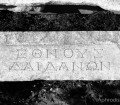
One of the most remarkable features of the stadium is the topos inscriptions found on the seating rows. These inscriptions indicate seats reserved for specific individuals and groups. Some seats were assigned to wealthy individuals, while others were reserved for professional associations or communities. Seats reserved for groups such as leatherworkers, goldsmiths, and other social groups show that the stadium was an important space reflecting the social order of Aphrodisias.
These inscriptions are valuable for understanding how social hierarchy and professional organization became visible in public spaces in the ancient city. Where someone sat in the stadium was not only a practical arrangement. It was also a marker of status, social belonging, and position within the city.
In this respect, Aphrodisias Stadium was not merely a structure for watching sports. It was a large public space where the social map of the city was inscribed into the marble seating rows. While competitions were watched here, the class, professional, and political relationships of the urban population also became visible in the space.
Relationship with the City Walls
The high walls to the north of the stadium were incorporated into the defensive system built in Aphrodisias during Late Antiquity. The city walls of Aphrodisias were constructed later than the stadium. For this reason, the northern part of the stadium was used as part of the defensive layout when the wall line was created.
The vaulted entrance gallery on the western side was also closed during the construction of the walls. This shows that the stadium was reused according to the changing urban needs of different periods. Originally designed for large athletic and festival events, the structure later became both a spectacle venue and an architectural element connected with the defensive system in Late Antiquity.
These transformations reveal that Aphrodisias was not only a city that built new structures, but also a living urban environment that could adapt its existing monuments to the needs of different periods.
Importance for the Visitor Experience
Today, for visitors to the Aphrodisias Archaeological Site, the stadium is one of the most impressive stops in the ancient city. When entering the structure, the continuity of the seating rows, the scale of the space, and the unity created by the closed ends allow visitors to directly sense the scale of mass events in the ancient world.
The stadium shows that Aphrodisias was a powerful city not only through its sculptures and temples but also through its public life and festival culture. The competitions, spectacles, and collective events held here must have occupied an important place in the social memory of the city.
Understanding the stadium at Aphrodisias is also important for understanding daily life in the ancient city. This structure functioned as a multilayered space where athletes, spectators, urban elites, professional associations, and visitors from surrounding communities came together.
Conclusion
Aphrodisias Stadium is one of the best-preserved and largest stadiums of the ancient world. With its length of approximately 270 meters, width of 60 meters, capacity of 30,000 people, marble seating rows, closed-ended plan, and inscriptions reflecting social order, it is a unique public structure.
The building provides strong evidence for the athletic, festival, spectacle, and social life of Aphrodisias. It was first designed for athletic competitions, later hosted different types of Roman-period spectacles, and in Late Antiquity its eastern end was transformed into an arena-like arrangement. Its relationship with the city walls also shows that the stadium continued to be used with different functions in later periods.
Today, Aphrodisias Stadium is not only a magnificent ancient structure but also a unique archaeological heritage site through which we can read the city’s social history, public life, and cultural transformation.