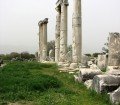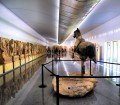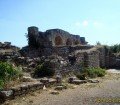
The Baths of Hadrian are the largest public bath complex in the Ancient City of Aphrodisias. Located in the western part of the city center, west of the Portico of Tiberius and the broad public area interpreted as the Urban Park, this structure is one of the most important buildings that brings together the social life, water architecture, marble craftsmanship, and public representation of Roman-period Aphrodisias.
In traditional accounts, the baths are associated with one of the visits of Roman Emperor Hadrian to Anatolia and are said to have been built in memory of this visit. Current research indicates that the building was constructed in the early 2nd century CE and dedicated to Hadrian. For this reason, it is more accurate to evaluate the structure as a monumental expression of the relationship that the Aphrodisias city council and local elites established with the Roman imperial world.
Location and General Plan
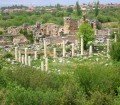
The Baths of Hadrian are a large building complex spread across a broad area in the public center of the ancient city. The baths are directly connected with the western colonnaded arrangement of the Urban Park. This location shows that the structure was not an isolated bath used only for bathing, but was integrated with the city center’s spaces for walking, resting, gathering, and social life.
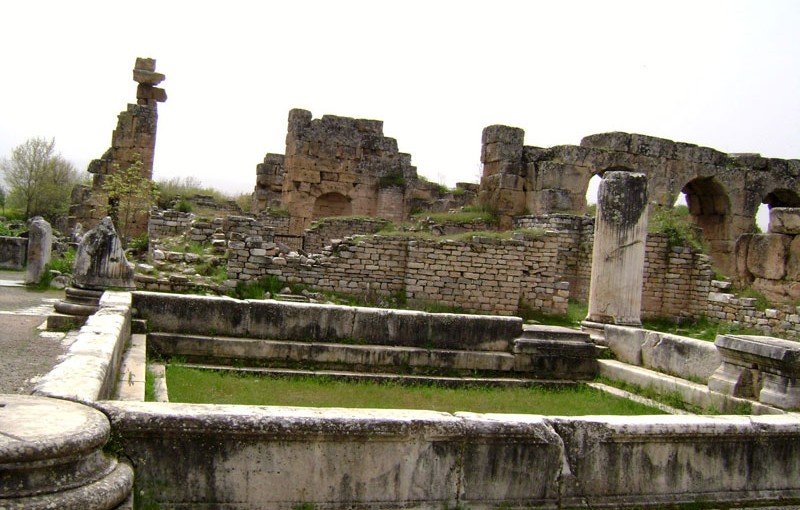
The building generally consists of two main parts. The first part includes the vaulted rooms reserved for bathing functions. The second part is the broad colonnaded courtyard at the front, known as the palaestra. This large courtyard strengthened the public character of the bath complex with functions such as exercise, rest, waiting, walking, and social gathering.
The older text states that the building consisted of two large sections where women and men bathed separately. In Roman baths, the use of separate hours or separate sections for women and men is known from different cities. For the Baths of Hadrian, rather than presenting this separation as a definite plan scheme, it is safer to say that the large scale of the building was capable of serving different user groups.
Bath Sections
The main bathing areas of the Baths of Hadrian carry the classical functions of Roman bath architecture. The building was organized with sequential rooms for undressing, cold bathing, warm bathing, and hot bathing.
The apodyterium was the section where visitors undressed and dressed. This area was the starting point of the bath experience. Visitors left their clothes here and then moved on to other spaces arranged according to temperature.
The frigidarium was the cold room. This space was generally associated with cold-water pools and was used to cool the body after the warmer sections. In Roman bath culture, the cycle of hot and cold water was important both for cleansing and bodily relaxation.
The tepidarium was the warm room. This area functioned as a transitional space between the cold and hot rooms. Visitors prepared their bodies for the warmer environment here before moving into higher-temperature sections.
The caldarium was the hot room. As one of the warmest spaces in the bath, this area was associated with hot water and steam. In the Baths of Hadrian, these rooms were supported by underfloor heating systems and service corridors.
In some descriptions, the sudatorium, or sweating room, is also included among the functional sections of the structure. This room provided sweating through high temperature and steam. Such spaces reflect the relationship between Roman baths, bodily care, and health.
Hypocaust and Heating System
One of the most important technical features of the Baths of Hadrian is the hypocaust system. The hypocaust was an advanced heating system used in Roman baths, in which hot air circulated beneath the floors and through the walls to heat the rooms. The service corridors, furnaces, channels, and galleries beneath the building were part of this system.
The complex galleries and passageways mentioned in the older text show that the bath was not only a magnificent architectural structure but also a large public facility operated with advanced engineering knowledge. This infrastructure allowed the hot rooms to be heated regularly, water to be directed properly, and the daily use of the baths to continue.
This system is an important example of how water, heat, and marble architecture came together in Aphrodisias. Considering the scale of the Baths of Hadrian, the operation of the building must have required serious technical organization, fuel use, water management, and maintenance.
Marble Architecture and the Palaestra Courtyard
Local stone and sandstone-like materials were used throughout the structure, while surfaces were covered with marble slabs. This was a common practice in Roman bath architecture. The main structural and wall fabric could be built with more practical materials, while marble revetment was preferred in areas with strong public and visual impact.
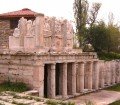
The palaestra, the front courtyard of the baths, was a highly decorated section with piers, columns, lintels, and a rich cornice arrangement. This area was not only a place for physical exercise but also a representational space that shaped the monumental entrance experience of the bath. Before entering the bathing rooms, visitors passed through this large courtyard and encountered the architectural grandeur of the building.
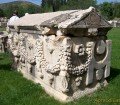
On the marble elements of the palaestra, there were acanthus leaves, Eros figures, human figures, and animal depictions reflecting the typical features of Aphrodisian art. These decorations show the mastery of the Aphrodisias School of Sculpture in architectural ornament. The sculptors of the city did not only produce freestanding statues. They also created high-quality works in the architectural decoration of buildings.
Giant Mythological Heads and Figural Consoles
One of the most striking decorative elements of the Baths of Hadrian is the group of giant mythological heads and figural console blocks. The older text notes that the giant mythological heads forming the console ends of the cornice are displayed on the garden walls at the entrance of the museum. These types of figural consoles belonged to the architectural decoration program of the palaestra courtyard.
Animals, mythological figures, and large protomes were carved on these consoles. A protome is a sculptural decorative element representing the head and upper body of a human or animal figure. These pieces gave movement, shadow, and strong visual impact to the upper architecture of the building.
The figural consoles of the Baths of Hadrian show that Aphrodisian craftsmen worked marble not only as regular blocks and surface cladding, but also as expressive figural architectural pieces. In this respect, the baths were more than a structure for cleansing. They were also a public display space for the city’s art.
The Place of Baths in Social Life
In Roman cities, baths were not only places for bathing. They were among the liveliest centers of social life. People bathed, rested, exercised, talked, exchanged news, and became part of urban life in these spaces. For this reason, the Baths of Hadrian are one of the key buildings for understanding the daily life of the people of Aphrodisias.
The large scale of the building shows that Aphrodisias was a powerful and wealthy city during the Roman period. The construction of such a large bath complex points to the city’s water resources, technical organization, economic strength, and public culture.
The close relationship between the Baths of Hadrian, the Urban Park, and the Portico of Tiberius shows that water, rest, walking, and bodily care were planned together in the western center of the city. For visitors, this area is one of the best places to sense the social life of Aphrodisias.
Early Excavations and Paul Gaudin
The first excavations in the Baths of Hadrian were carried out in 1904 by the French railway engineer and amateur archaeologist Paul Gaudin. These early excavations were an important beginning in the modern research history of Aphrodisias. However, the excavation and artifact protection practices of that period were very different from today’s standards.
During the work carried out in 1904 and 1905, many artifacts were uncovered from the Baths of Hadrian and the area around the Temple of Aphrodite. Some of these objects were taken to the Istanbul Archaeological Museums, while others were sold in Izmir and Europe. This shows how early archaeological activity could lead to problematic consequences in terms of artifact protection and cultural heritage.
The older text states that Prof. Dr. Kenan Erim proved that the body of a fisherman statue, whose head he found in the Portico of Tiberius in 1989, had been sold to the Pergamon Museum in Berlin by Gaudin’s heirs. In the current narrative, this detail can be treated as an example of how some artifacts from Aphrodisias were dispersed abroad during the early excavation period. Such pieces show that archaeological artifacts should be evaluated not only aesthetically, but also in terms of provenance, context, and cultural heritage.
Importance for Conservation and Research
The Baths of Hadrian are an important research area in Aphrodisias both architecturally and in terms of conservation. The large scale of the building, its water and heating systems, marble coverings, figural consoles, and later-period alterations make it a multilayered subject of study.
The preservation of bath structures is difficult because of open-air conditions, water accumulation, material decay, and earlier interventions. Documenting the marble revetments, figural blocks, hypocaust system, and wall fabric is highly important for long-term conservation work.
The Baths of Hadrian show that Roman-period Aphrodisias was not only a city of magnificent sculptures and temples. Daily life, public health, social interaction, water management, and engineering were also highly developed in the city.
Conclusion
The Baths of Hadrian are the largest and most important public bath complex in Aphrodisias. Built in the early 2nd century CE and dedicated to Hadrian, this complex is located west of the Urban Park and is directly connected with the social life of the city. With its undressing, cold, warm, hot, and sweating rooms, hypocaust system, broad palaestra courtyard, and rich marble decoration, the building is the strongest representative of Roman bath architecture in Aphrodisias.
The acanthus leaves, Eros figures, human and animal depictions, giant mythological heads, and figural consoles in the palaestra clearly reveal the high level of Aphrodisian marble craftsmanship. The early excavations initiated by Paul Gaudin in 1904 show the building’s importance in the modern research history of the site, while also reminding us that artifacts should be protected and evaluated within their original context.
Today, the Baths of Hadrian are a valuable archaeological heritage site that allows visitors to read Roman urban life, engineering knowledge, water culture, and public architecture together during a visit to Aphrodisias.