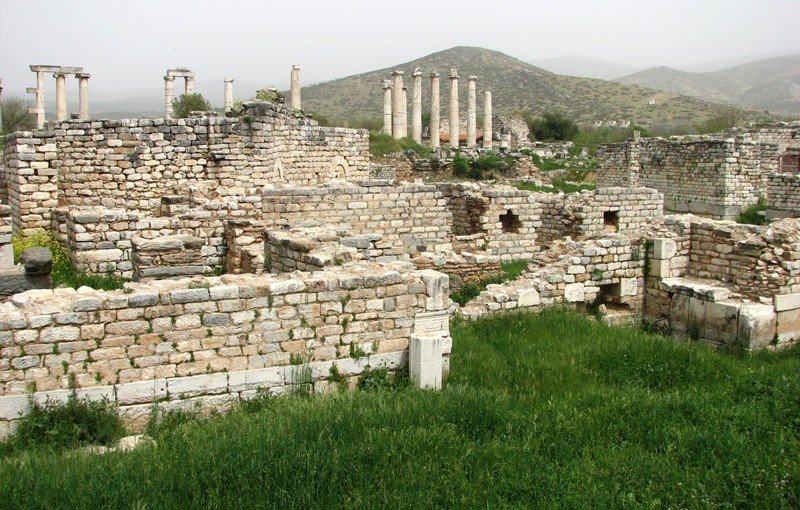
The area around the Aphrodisias Odeon is highly important for understanding the central public fabric of the ancient city. This area contains not only a roofed building used for council meetings, concerts, and performances, but also a monumental tomb, a late-period residential structure, an administrative representation space, and architectural traces related to the Christianization process. For this reason, the area around the Odeon is an important place for reading the transformation of Aphrodisias from the Roman period to Late Antiquity.
The Monumental Tomb Behind the Odeon
Behind the Odeon, there is a circular-planned monumental tomb area surrounded by columns. At its center stands a sarcophagus, and the structure was most likely built for a well-known and wealthy individual from Aphrodisias. In ancient cities, such tombs functioned not only as burial places but also as public memory structures that displayed the social status of the deceased, the power of the family, and their prestige within the city.
Aphrodisias had a highly developed sarcophagus tradition. Many sarcophagi, sarcophagus lids, and funerary fragments have been found in the city. This shows that Aphrodisias had a strong production tradition in both marble craftsmanship and funerary art. The inscriptions and reliefs on sarcophagi can provide information about the identity of the deceased, their family, social position, and sometimes the conditions of use of the tomb.
The monumental tomb near the Odeon should also be evaluated within this context. Its location close to an important public building such as the Odeon suggests that the tomb owner held a visible and privileged position within the city. In ancient cities, the tombs of elite individuals were often placed near busy roads, public buildings, or monumental areas. In this way, the memory of the deceased remained alive within the daily movement of the urban population.
Sarcophagus and Public Memory
A sarcophagus in Aphrodisian art was not merely a burial container. It was also an important part of marble craftsmanship, figural relief tradition, and social representation. Aphrodisian craftsmen used garlands, mythological scenes, portraits, columnar arrangements, and inscription panels on sarcophagi to visually express the status of the tomb owner.
For this reason, the sarcophagus monument behind the Odeon is an important example for understanding the funerary culture and social memory of Aphrodisias. While the city’s elites became visible during their lifetimes through contributions to public buildings or honorific statues, they also continued to exist within the urban fabric after death through monumental tombs.
This structure shows that the area around the Odeon was not only a political and cultural center, but also carried functions of commemoration and representation.
The Structure Known as the Bishop’s Palace
On the western side of the Odeon stands a large building complex notable for its high walls and broad plan. This structure has long been known as the Bishop’s Palace. However, current research shows that the history of the building is more complex and that this name is probably appropriate only for its latest phases of use.
In current literature, the building is mostly evaluated as the Triconch House. This name comes from its most distinctive feature, the large reception hall with three apses. The term “triconch” refers to a space with three semicircular apses. This plan type is a monumental arrangement seen in elite domestic architecture and representative buildings of the Late Roman period.
The large scale of the building, covering approximately one city block, together with its central location, peristyle courtyard, private rooms, and three-apsed reception hall, shows that it was not an ordinary residence. It was most likely used in the Late Roman period as a high-status residence with strong representative character, possibly belonging to an elite family, a high-ranking official, or an important figure connected with provincial administration.
Architectural Layout and Peristyle Courtyard
The Triconch House consists of rooms arranged around a large courtyard. Columns surrounded the central courtyard, a layout known in ancient domestic architecture as a peristyle courtyard. Peristyle courtyards were central spaces that provided both light and air while organizing the social life of the house.
One of the notable elements of the building is its blue-toned marble columns. The marble resources in and around Aphrodisias made it possible to use stones of different colors and textures in buildings. These columns show that the structure was designed not only as a functional building but also as a visually impressive space of representation.
The large three-apsed hall is the most monumental part of the building. This hall may have been used for receiving guests, official meetings, dining arrangements, or ceremonial gatherings. In the Late Roman world, such apsidal halls were important tools for displaying the social status and public authority of the owner.
Late Roman Residence and Possible Administrative Function
It is possible that the building was associated at some stage with a provincial governor or a high-ranking official. However, it would not be accurate to define it in a single definitive way. A safer interpretation is that the structure may have functioned in the Late Roman period as an elite residence or an administrative representative building.
This interpretation is supported by the size of the building, its location in the city center, its monumental reception hall, and its relationship with nearby public structures. Its proximity to the Odeon, North Agora, temple area, and other public buildings suggests that the Triconch House held an important place in the late-period administrative and social life of Aphrodisias.
From this perspective, the building is a striking example of how public and private spaces could come close to one another in Aphrodisias. On the one hand, it has the characteristics of domestic architecture. On the other hand, it offers a plan open to representation and administrative functions.
Christianization and Episcopal Use
Aphrodisias entered a process of Christianization in Late Antiquity and gradually came to be known as Stauropolis. During this process, some pagan buildings were transformed, new religious structures appeared, and some large residences or administrative buildings in the city center became associated with Christian institutions.
The name Bishop’s Palace is also connected with this late-period use. The building may have been associated with episcopal structures, especially in its later phases. However, explaining the entire history of the building only as a bishop’s residence would be incomplete. In its earlier phases, the structure should be evaluated as a large residential complex reflecting the life and representative culture of the Late Roman urban elite.
For this reason, the most accurate approach is to consider the building first as a Late Roman elite residence or administrative representative structure, and in later phases as a building connected with the Christian urban order.
The Importance of the Odeon Area within the City
When the Odeon, the monumental tomb, and the Triconch House are considered together, it becomes clear that this area had a multilayered function in the center of Aphrodisias. Council meetings, musical performances, public honors, elite domestic life, commemorative structures, and late-period religious transformations can all be traced here.
This density shows that Aphrodisias was enriched not only by major monuments such as its temple, stadium, and theater, but also by smaller structures in the city center that carried strong meaning. The area around the Odeon was a point where daily public life and elite representation culture intersected.
The monumental tomb reflects the memory of the city’s elite. The Triconch House reflects the social and administrative representation of the Late Roman period. The name Bishop’s Palace reflects the city’s new identity during the Christianization process. For this reason, the area allows different periods of Aphrodisias to be read within the same space.
Conclusion
The monumental tomb behind the Odeon and the structure to its west known as the Bishop’s Palace are important architectural elements that complete the central public area of Aphrodisias. While the monumental tomb represents elite memory and funerary art, the large building interpreted as the Triconch House brings together Late Roman domestic architecture, administrative representation, and later Christian phases of use.
These two structures show that Aphrodisias was a multilayered city not only through its performance, council, and temple buildings, but also through spaces of commemoration, residence, administration, and religious transformation. Today, the area around the Odeon is a valuable archaeological heritage zone that allows visitors to read social, political, and religious changes from the Roman period to Late Antiquity together.





![[:tr]Prof. Dr. Kenan Erim[:]](https://www.aphrodisias.org/wp-content/uploads/2014/12/prof-dr-kenan-erim-120x105.jpg)