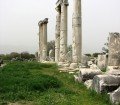
The Tetrapylon is one of the most recognizable and impressive monumental structures of the Ancient City of Aphrodisias. Located just east of the temple, on the north-south main street, this magnificent gateway is a symbolic entrance structure emphasizing the passage into the Sanctuary of Aphrodite. Today, the Tetrapylon is one of the first monuments that comes to mind when Aphrodisias is mentioned, and it stands among the city’s strongest visual symbols with both its architectural richness and successful restoration.
The structure dates to the 2nd century CE, especially to the Antonine period. Its name consists of two Greek words. “Tetra” means four, and “pylon” means gate. Since the structure opens in four directions and consists of sixteen columns in total, it is called the Tetrapylon. With four columns on each façade, it creates a four-sided monumental passage arrangement.
Location and Function
The Tetrapylon stands east of the Temple of Aphrodite. It is not positioned exactly on the axis of the temple. Therefore, it should not be understood simply as the direct entrance gate of the temple. However, it can be assumed that ceremonial processions approaching the sacred area gathered at this point and then moved toward the temple precinct.
In the ancient city, the Tetrapylon marked the transition between the public street and the sacred area. Visitors entered from the east, from the north-south main street, and after passing through the gateway, reached a more special space belonging to the sanctuary of Aphrodite. This passage was not only a physical change of direction, but also a symbolic transition from the public space into a sacred area.
In this respect, explaining the Tetrapylon only as a practical gate would be incomplete. The structure is a prestigious monument designed by Aphrodisian architects and marble craftsmen to strengthen the religious and ceremonial experience of the city.
Architectural Features
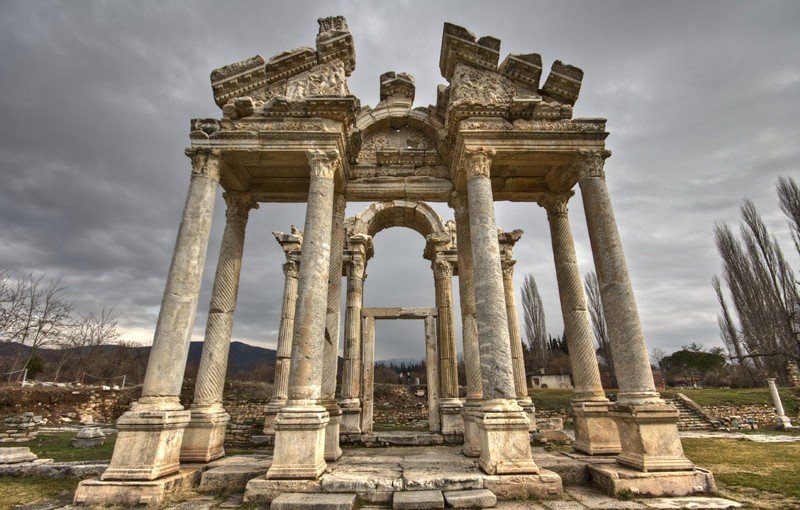
The Tetrapylon is a richly decorated monumental gateway designed in the Corinthian order. Plain, fluted, and spiral-fluted columns were used together in the structure. Some columns were arranged to create the effect of paired columns, giving the monument a more dynamic and ornate appearance. In some sections, blue-toned marble creates a strong color contrast together with white marble.
The marble quarries near Aphrodisias made high-quality architectural and sculptural production possible in the city. The Tetrapylon is one of the most striking examples of this tradition. With its columns, capitals, pediments, and relief decoration, the structure shows that Aphrodisian craftsmen used marble not only as a structural material but also as a medium of visual expression.
The pediments and column arrangements on all four sides allow the viewer to experience a changing architectural effect from different directions. For this reason, the Tetrapylon should be understood not as a single-fronted gateway, but as a three-dimensional monumental structure visible from every side.
Western Pediment and Decoration
One of the most striking parts of the Tetrapylon is its western façade. The western pediment presents a rich architectural composition with its broken pediment arrangement. On this façade, Erotes emerging among acanthus leaves, hunting scenes, and lively decorative motifs are depicted. This composition clearly shows the attention Aphrodisian marble craftsmanship gave to fine detail.
The western façade functioned as the inner face visible when looking back from the sacred area. For this reason, it was decorated more richly than the eastern façade. The more elaborate treatment of the inward-facing side was a deliberate architectural choice that made visitors feel they had entered the precinct of Aphrodite and become part of a sacred space.
In the semicircular central section of the western pediment, there is thought to have been a figure of Aphrodite. This figure was damaged during the Christian period and replaced with a roughly carved cross. This intervention is one of the architectural traces of Aphrodisias’ transition from its pagan past to the Christian period.
Eastern Façade and Symbolic Appearance
The eastern façade was the first side seen by visitors approaching from the main street. The semicircular arch and column arrangement on this façade gave the structure an elegant and monumental appearance. As described in the original text, this façade created a strong visual effect in the morning and evening light. In the marble structures of Aphrodisias, the way light falls on the surfaces significantly changes the architectural perception.
The eastern façade served as a threshold welcoming visitors approaching the sacred area. The rhythm of the columns, the brightness of the marble, the pediment arrangement, and the decoration made the magnificent urban identity of Aphrodisias felt at the very point of entry.
The Nike, Eros, and acanthus decorations on the structure bring together associations of victory, fertility, love, and sacredness. Therefore, the Tetrapylon should be seen not only as an architectural form but also as a symbolic narrative space connected with the cult of Aphrodite.
Restoration and Re-Erection
The impressive appearance of the Tetrapylon today is the result of a comprehensive restoration carried out in the late 20th century. The restoration was conducted using the anastylosis method. Anastylosis means re-erecting an ancient structure by placing original stone blocks back in their proper positions as much as possible.
The restoration of the Tetrapylon was one of the projects to which Kenan Erim gave the greatest importance. Carried out between 1983 and 1990, the work was completed through the collaboration of Austrian architects, Turkish archaeologists, and local craftsmen. Examining the stones one by one, documenting the fragments, placing suitable blocks in their original locations, and completing missing parts in a readable way was a long and demanding process.
Current excavation sources state that the stone-by-stone re-erection of the Tetrapylon was completed in 1991 and that approximately 85 percent of the original blocks were used in the structure. This ratio shows how strongly the restoration was based on archaeological evidence. The 80 percent figure in the original text is close in general meaning, but current sources emphasize the 85 percent rate.
The restoration of the Tetrapylon fundamentally changed the modern visitor experience at Aphrodisias. Today, visitors can see not only scattered fallen blocks but also the kind of monumental effect the structure may have created in antiquity. For this reason, the Tetrapylon is considered one of the most remarkable ancient building restorations in Anatolia.
The Grave of Kenan Erim
Just east of the Tetrapylon stands a modest grave made of white marble from the Aphrodisias quarries. This grave belongs to Prof. Dr. Kenan T. Erim, who devoted much of his life to the excavation, preservation, and promotion of Aphrodisias.
Kenan Erim began modern excavation work at Aphrodisias in 1961 and served as excavation director for nearly thirty years. The theater, stadium, Sebasteion, Tetrapylon, and many other important structures of the ancient city were systematically uncovered during his time. He was one of the figures who contributed most to Aphrodisias becoming known worldwide.
Kenan Erim, who devoted great effort to the restoration of the Tetrapylon, passed away shortly after the completion of the restoration and its opening in 1990 by the then President Turgut Özal. In accordance with his wishes, he was buried at Aphrodisias, beside the Tetrapylon, the city he loved so deeply.
This grave is not only a memorial point during a visit to Aphrodisias. It is also a symbol of modern archaeology, personal dedication, and deep commitment to cultural heritage.
The Importance of the Tetrapylon within Aphrodisias
The Tetrapylon is one of the structures that best reflects the identity of Aphrodisias. It emphasizes the entrance to the Sanctuary of Aphrodite, demonstrates the city’s monumental architectural vision, and clearly reveals the technical skill of Aphrodisian craftsmen in marble.
In Aphrodisias, marble was not merely a building material. It was one of the main elements reflecting the city’s economic strength, artistic level, and cultural identity. The Tetrapylon stands out as one of the most visible and impressive examples of this marble tradition.
The structure formed an important threshold in terms of religious ceremonies, the perception of the sacred area, urban circulation, and visual representation. For this reason, the Tetrapylon should not be understood only as a “four-gated structure,” but as a monumental passageway connecting the sacred and public worlds of Aphrodisias.
Conclusion
The Tetrapylon of Aphrodisias is a monumental gateway built in the 2nd century CE, designed in the Corinthian order and composed of sixteen columns. Emphasizing the entrance to the Sanctuary of Aphrodite, the structure is one of the most magnificent examples of Aphrodisian architecture with its rich pediment decoration, Eros and Nike figures, acanthus leaves, different column types, and use of blue and white marble.
The restoration carried out in the 20th century is one of the most important works in the modern archaeological history of Aphrodisias. Re-erected using a large proportion of original blocks, the Tetrapylon now stands as a powerful symbol that allows visitors to directly sense the grandeur of the ancient city.
The grave of Kenan Erim, located just beside the Tetrapylon, gives the monument an additional meaning. On one side stands the work of the ancient craftsmen of Aphrodisias, and on the other, the memory of the archaeologist who reintroduced this city to the modern world. For this reason, the Tetrapylon is one of the most valuable archaeological heritage structures of Aphrodisias, carrying both its ancient and modern history together.